Showing posts with label history. Show all posts
Week 11.2: Invisible Hands (Electronics)
Reading:
Invisible Hands, 289-294, 315-338, 366-370
INTERVIEW PROPOSAL DUE
Study Questions:
1. Do a quick Internet search for the phrase "invisible hand." What does this phrase mean? Where does it come from? Why has this book been called Invisible Hands? What is the point the editors are trying to get across?
2. What did you learn from today's reading? How are you personally implicated by what you've read? What does this mean for you?
Week 11.1: Invisible Hands (Resource Extraction)
![]() | ||||
| Harold C. Harvey, St. Just Tin Miners (1935) |
Invisible Hands, 191-196
Either Albert Mwanaumo or Clive Porabou interview
Viewing: Harold C. Harvey, St. Just Tin Miners (website)
Study Questions:
1. Consider the shape of the oral histories that you've read so far. How do they all begin? How do they progress? Where have they tended to end? How might you use this in shaping your own oral history?
2. What strikes you as the most interesting/significant aspect of the oral history that you read today? What do you believe you should take away from the oral history? What do your peers need to know about the oral history you read?
Week 10.2: Invisible Hands (Agriculture)
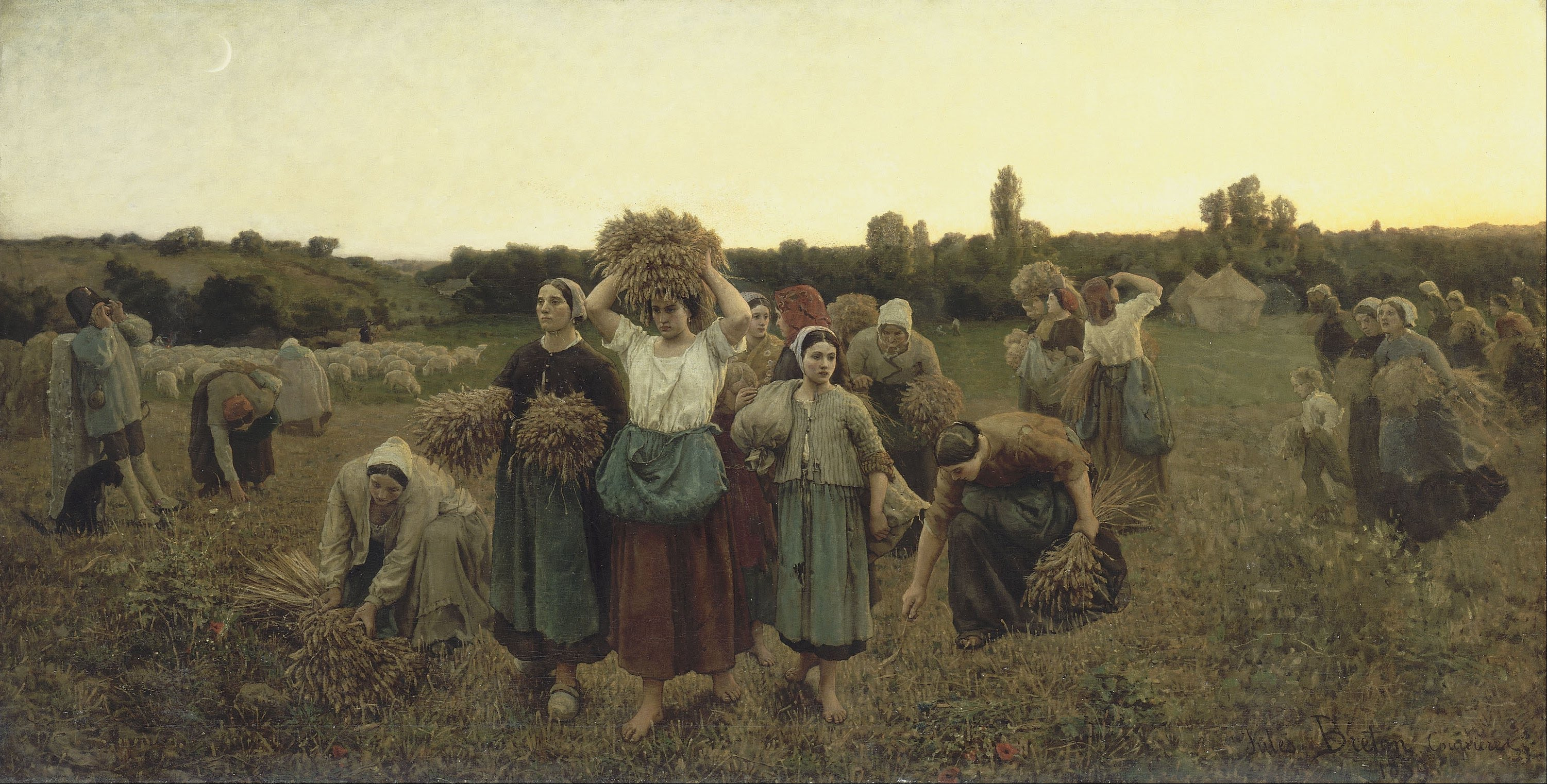
| Jules Breton, Calling in the Gleaners (1859) |
Invisible Hands, 107-112
Acuna-Arias (Akolkar Interview)
Cortez-Hardy (Opa Interview)
Hendriksz-MacCarillo (Cocon Interview)
Myers-Sage (Guzman)
Sedighi-Zapeda (Cuello)
Viewing: Jules Breton, Calling in the Gleaners (website)
Study Questions:
1. What connections can you make between the reading you did for today and the reading that you did for last session on "The Garment Industry"? What seems similar between the two narratives? What seems unique?
2. Read over the oral history very carefully. Select the largest section of the narrative and try to imagine what questions the interviewer asked to get the subject to talk? How do you imagine these questions were phrased? What questions would you ask?
Review:
Labels:
Corinne Goria,
France,
Guatemala,
history,
India,
Invisible Hands,
Jules Breton,
Oral History,
United States,
Uzbekistan
Week 2.2: Max Weber, The Protestant Ethic and the Spirit of Capitalism
![]() | |||
| Joseph Duplessis, Benjamin Franklin (1778) |
Arguably the foremost social theorist of the twentieth century, Max
Weber (1864-1920) is known as a principal architect of modern social science
along with Karl Marx and Emil Durkheim. Weber's wide-ranging
contributions gave critical impetus to the birth of new academic
disciplines such as sociology and public administration as well as to
the significant reorientation in law, economics, political science,
and religious studies. His methodological writings were instrumental
in establishing the self-identity of modern social science as a
distinct field of inquiry; he is still claimed as the source of
inspiration by empirical positivists and their hermeneutic detractors
alike. More substantively, Weber's two most celebrated contributions
were the “rationalization thesis,” a grand meta-historical
analysis of the dominance of the west in modern times, and the
“Protestant Ethic thesis,” a non-Marxist genealogy of
modern capitalism. Together, these two theses helped launch his
reputation as one of the founding theorists of modernity. In addition,
his avid interest and participation in politics led to a unique strand
of political realism comparable to that of Machiavelli and Hobbes. As
such, Max Weber's influence was far-reaching across the vast array of
disciplinary, methodological, ideological and philosophical reflections
that are still our own and increasingly more so. (From the Stanford Encyclopedia of Philosophy)
Read:
Max Weber, The Protestant Ethic and the Spirit of Capitalism, 120 (first section), 1-20 (middle of the page), 23-28
Watch:
Study Questions:
1. Weber structures his argument inductively, meaning that rather than starting with a thesis he works from examples and from that generates a conclusion. While this is a perfectly logical way of structuring an essay, if you are used to a more deductive form of argumentation it might seem unwelcoming. In order to help your comprehension of the piece, I would like you to summarize pages one through seven. What is the problem that Weber poses? Where does he seek to find the solution?
2. How does Benjamin Franklin represent the "spirit of capitalism"? How does this relate to the concept of a "calling"?
Subscribe to:
Posts (Atom)