Showing posts with label Corinne Goria. Show all posts
Week 11.2: Invisible Hands (Electronics)
Reading:
Invisible Hands, 289-294, 315-338, 366-370
INTERVIEW PROPOSAL DUE
Study Questions:
1. Do a quick Internet search for the phrase "invisible hand." What does this phrase mean? Where does it come from? Why has this book been called Invisible Hands? What is the point the editors are trying to get across?
2. What did you learn from today's reading? How are you personally implicated by what you've read? What does this mean for you?
Week 11.1: Invisible Hands (Resource Extraction)
![]() | ||||
| Harold C. Harvey, St. Just Tin Miners (1935) |
Invisible Hands, 191-196
Either Albert Mwanaumo or Clive Porabou interview
Viewing: Harold C. Harvey, St. Just Tin Miners (website)
Study Questions:
1. Consider the shape of the oral histories that you've read so far. How do they all begin? How do they progress? Where have they tended to end? How might you use this in shaping your own oral history?
2. What strikes you as the most interesting/significant aspect of the oral history that you read today? What do you believe you should take away from the oral history? What do your peers need to know about the oral history you read?
Week 10.2: Invisible Hands (Agriculture)
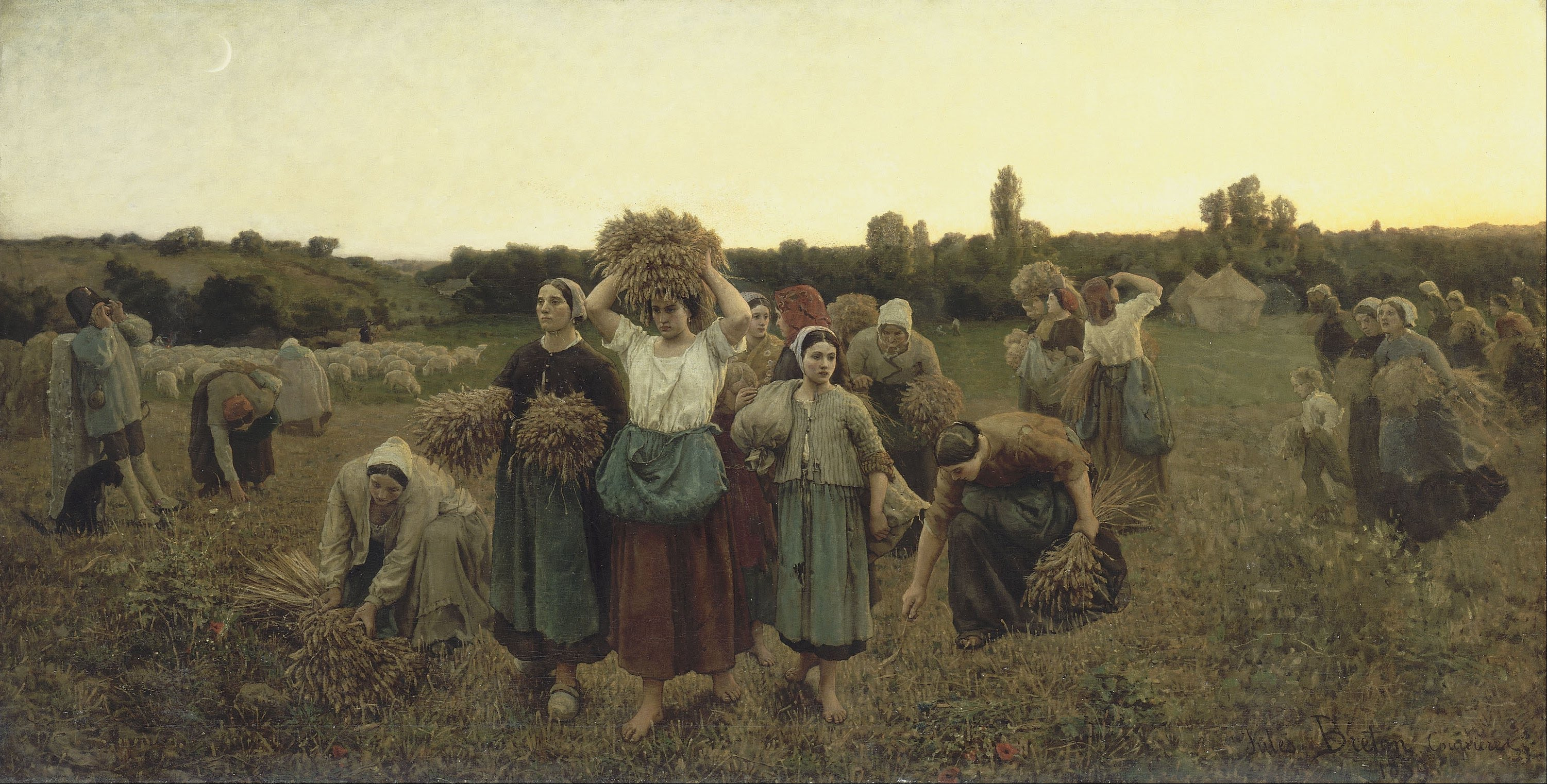
| Jules Breton, Calling in the Gleaners (1859) |
Invisible Hands, 107-112
Acuna-Arias (Akolkar Interview)
Cortez-Hardy (Opa Interview)
Hendriksz-MacCarillo (Cocon Interview)
Myers-Sage (Guzman)
Sedighi-Zapeda (Cuello)
Viewing: Jules Breton, Calling in the Gleaners (website)
Study Questions:
1. What connections can you make between the reading you did for today and the reading that you did for last session on "The Garment Industry"? What seems similar between the two narratives? What seems unique?
2. Read over the oral history very carefully. Select the largest section of the narrative and try to imagine what questions the interviewer asked to get the subject to talk? How do you imagine these questions were phrased? What questions would you ask?
Review:
Labels:
Corinne Goria,
France,
Guatemala,
history,
India,
Invisible Hands,
Jules Breton,
Oral History,
United States,
Uzbekistan
Week 10.1: Invisible Hands (The Garment Industry)
![]() |
| Edgar Degas, The Milliners (ca. 1882) |
Today we begin reading Corinne Goria's Invisible Hands: Voices from the Global Economy. Like Studs Terkel's Working, Invisible Hands is an oral history. Like other oral histories published as part of McSweeney's Voice of the Witness series, Invisible Hands has "the mission of using oral history to illuminate contemporary human rights crises."
Over the next two weeks, we will be reading selections from this collection in order to better understand how to produce our own oral histories. While our subsequent lessons will be focused primarily on how Goria and her collaborators produced these oral histories and conducted interviews, today we will be focused almost exclusively on content. Last Wednesday, you should have been assigned a selection from "The Garment Industry" section in the book. If you were not assigned one or were absent, you need to contact me ASAP so that you know what passage to read.
Reading:
Invisible Hands, 13-24, 29-33
One interview from "The Garment Industry" section
Acuna-Dickens (Aketer Interivew)Emory-Maccarillo (Juarez interview)
Myers-Zapeda (Barrios interview)
Viewing: Edgar Degas, The Milliners (website)
Study Questions:
1. Summarize the events described in your oral history. What do you believe is the most important aspect of the oral history your read?
2. Select a significant passage to share with the class. What is significant about it?
3. Look at the painting by Degas above. How might you be able to relate this depiction of 19th-century milliners (hat makers) to what we read today in Invisible Hands?
the
mission of using oral history to illuminate contemporary human rights
crises - See more at:
http://voiceofwitness.org/about/#sthash.2BM0jGiG.dpuf
the
mission of using oral history to illuminate contemporary human rights
crises - See more at:
http://voiceofwitness.org/about/#sthash.2BM0jGiG.dpuf
the
mission of using oral history to illuminate contemporary human rights
crises - See more at:
http://voiceofwitness.org/about/#sthash.2BM0jGiG.dpuf
the
mission of using oral history to illuminate contemporary human rights
crises - See more at:
http://voiceofwitness.org/about/#sthash.2BM0jGiG.dpuf
the
mission of using oral history to illuminate contemporary human rights
crises - See more at:
http://voiceofwitness.org/about/#sthash.2BM0jGiG.dpuf
Subscribe to:
Posts (Atom)

