John Locke (1632-1704) was a British philosopher, Oxford
academic and medical researcher. Locke's monumental
An Essay
Concerning Human Understanding (1689) is one of the first great
defenses of empiricism and concerns itself with determining the limits
of human understanding in respect to a wide spectrum of topics. It
thus tells us in some detail what one can legitimately claim to know
and what one cannot. Among Locke's political works he is most
famous for
The Second Treatise of Government in which he
argues that sovereignty resides in the people and explains the nature
of legitimate government in terms of natural rights and the social
contract. He is also famous for calling for the separation of Church
and State in his
Letter Concerning Toleration. Much of
Locke's work is characterized by opposition to authoritarianism. This
is apparent both on the level of the individual person and on the
level of institutions such as government and church. For the
individual, Locke wants each of us to use reason to search after truth
rather than simply accept the opinion of authorities or be subject to
superstition. He wants us to proportion assent to propositions to the
evidence for them. On the level of institutions it becomes important
to distinguish the legitimate from the illegitimate functions of
institutions and to make the corresponding distinction for the uses of
force by these institutions. Locke believes that using reason to try
to grasp the truth, and determine the legitimate functions of
institutions will optimize human flourishing for the individual and
society both in respect to its material and spiritual welfare. This in
turn, amounts to following natural law and the fulfillment of the
divine purpose for humanity. (adapted from the
Stanford Encyclopedia of Philosophy)
Reading:
John Locke, "The Second Treatise of Government" (395-404)
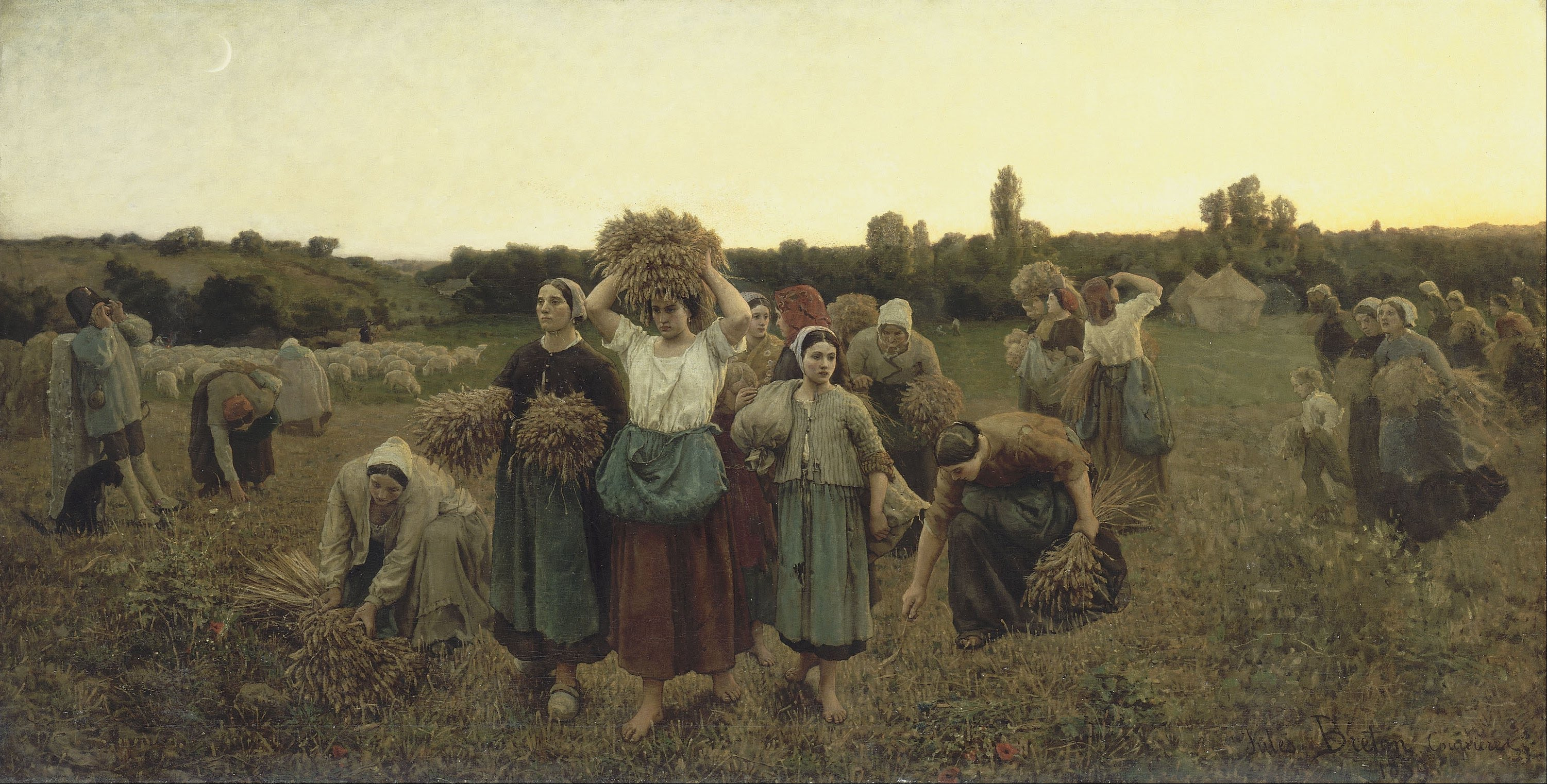
Viewing: Georges Lacombe, Chestnut Gatherers (1893)
Review: Debate Assignment
Today's Reading Can Be Found in Our Course Packet
Study Questions:
1. What is Locke's theory of property? How does this relate to the
founding of political communities?
2. What is the connection between his
assumptions about property and slavery?
3. What does the debate assignment ask you to do? What questions do you have?